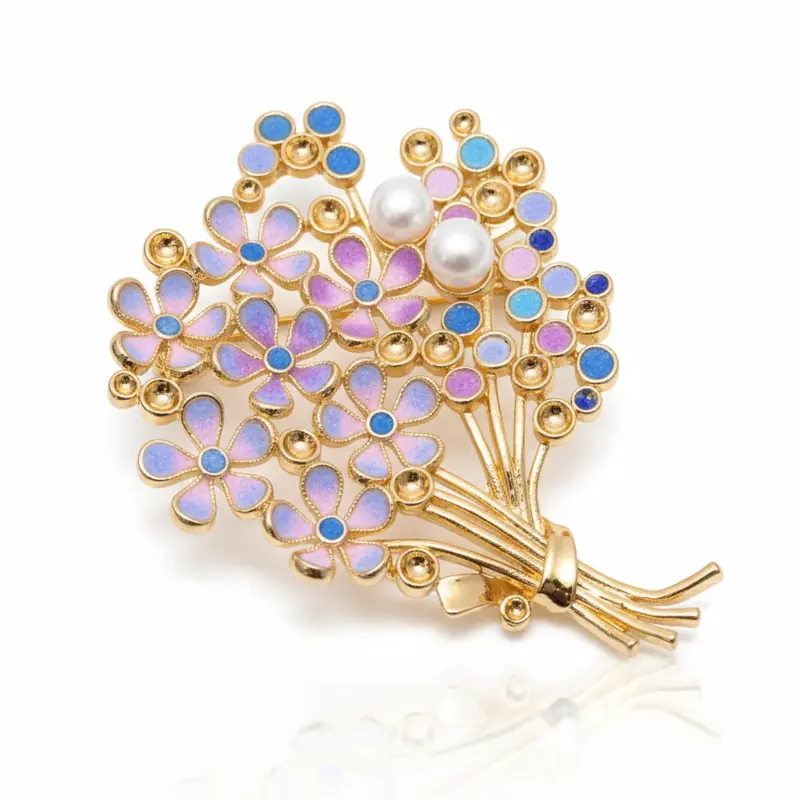
What cloisonné actually is.
Most people first read a cloisonné work as a picture — landscape, flower-and-bird, deity, ornament. Approach it closely and the difference becomes physical: every line is a length of metal wire that has been bent, fixed and shaped on a body; every colour is mineral enamel that has been settled inside the cell that wire encloses, then fixed or fired into place.
In one sentence, cloisonné is a technique that draws its image with metal wires and fills the colour into the cells those wires enclose. The wire decides the line, the contour and the rhythm; the enamel brings the colour, the grain and the light.
Take it apart — the layers that make it.
A finished cloisonné work reads as a single picture, but it is a stack of decisions. Click any layer to see what it does.
Wire
Forms the contour and is the skeleton of the work. Direction sets the rhythm of the image; density decides how fine the picture can become.
Note: traditional cloisonné objects (jingtailan) and contemporary cloisonné painting do not follow exactly the same workflow. What matters is the shared core: wire builds the structure, enamel enters the boundary, and human judgement decides the surface.
How a single wire becomes structure.
In ordinary painting, the line is a brushstroke. In cloisonné, the line is a length of metal — bent, adjusted and fixed. A single 0.3–0.5 mm wire is asked to do three things at once on a copper body: draw the contour, separate the colours, and hold the composition together.
A wire does at least three jobs at the same time. First, contour: it draws the edges of the mountain, the petal, the cloud, the halo, the robe or the ornament. Second, separation: it keeps each colour inside its own cell. Third, order — once a composition becomes complex, the wires are not decoration; they are the organising grammar of the picture.
So wiring is never simply “laying lines.” It is the act of translating a two-dimensional drawing into something that can actually be built — a drawing on paper is not yet a drawing in wire.
Filling, not painting.
Enamel filling is often mistaken for colouring. It is not. Every cell is a container; every pass has to account for the powder’s grain, the slurry’s moisture, the thickness against the wire and the layering against the cell beneath.
Firing or fixing binds enamel to its boundary. The colour shifts from a wet glaze into a material surface.
The colour of cloisonné comes from this materiality. It is not a screen colour and it is not the flat covering colour of paint. The grain catches light, the surface reflects unevenly, and the piece reads differently up close than from across the room.
Firing, fixing, polishing — finishing the surface.
Wiring and filling are not the end. Traditional cloisonné objects are typically fired, refilled, fired again, polished and gilded across multiple cycles. Contemporary cloisonné paintings and parts of the eastern enamel jewellery line use the filling, fixing and mounting routes that best suit their form.
Cloisonné is not one fixed thing. It can be an object, a piece of jewellery, a painting, or a thangka. Different forms make different demands on the body, on the enamel, on the surface treatment and on the mounting. But the constant is the same: wire forms the boundary, enamel enters the boundary, and the surface is judged by hand.
Why it is slow — and what cannot be compressed.
Many stages of cloisonné cannot be sped up. What is actually expensive about it is the time, the experience, the patience and the irreducible hand-work.
- 01
Translate the design
A beautiful drawing is not automatically a cloisonné drawing. It has to be translated into a structure that wires can actually build.
- 02
Bend and lay the wire
Every wire is bent, adjusted and fixed by hand. The more complex the line, the longer it takes.
- 03
Fill with enamel
Enamel is settled into each cell, never brushed across it. Edges and layers are corrected, again and again.
- 04
Let material rest
Drying, fusing and firing all require their own waiting time. Most of it cannot be compressed.
- 05
Finish the surface
Depending on the form — object, painting or jewellery — the route is firing, fixing, polishing or mounting.
- 06
Mount and judge
Lines, colour, edges, and overall atmosphere are judged one last time by eye and experience.
Cloisonné, jingtailan, and ordinary painting.
These terms are often used interchangeably. The table and the three cards below separate them by method and by form.
| Dimension | Conventional painting | Cloisonné enamel |
|---|---|---|
| Line | Drawn by brush | Shaped from metal wire |
| Colour | Pigment laid on the surface | Mineral enamel settled inside cells |
| Texture | Largely flat | Grain, depth and inner reflection |
| Process | Mostly pictorial | Design, wiring, filling, firing/fixing and mounting combined |
| Value | Image, brushwork, authorship | Image, material, craft and time together |
Jingtailan (Cloisonné objects)
Built on a copper body, with shaping, wiring, enamelling, firing, polishing and gilding — the historical Chinese cloisonné system perfected under the Ming Jingtai emperor.
Cloisonné painting
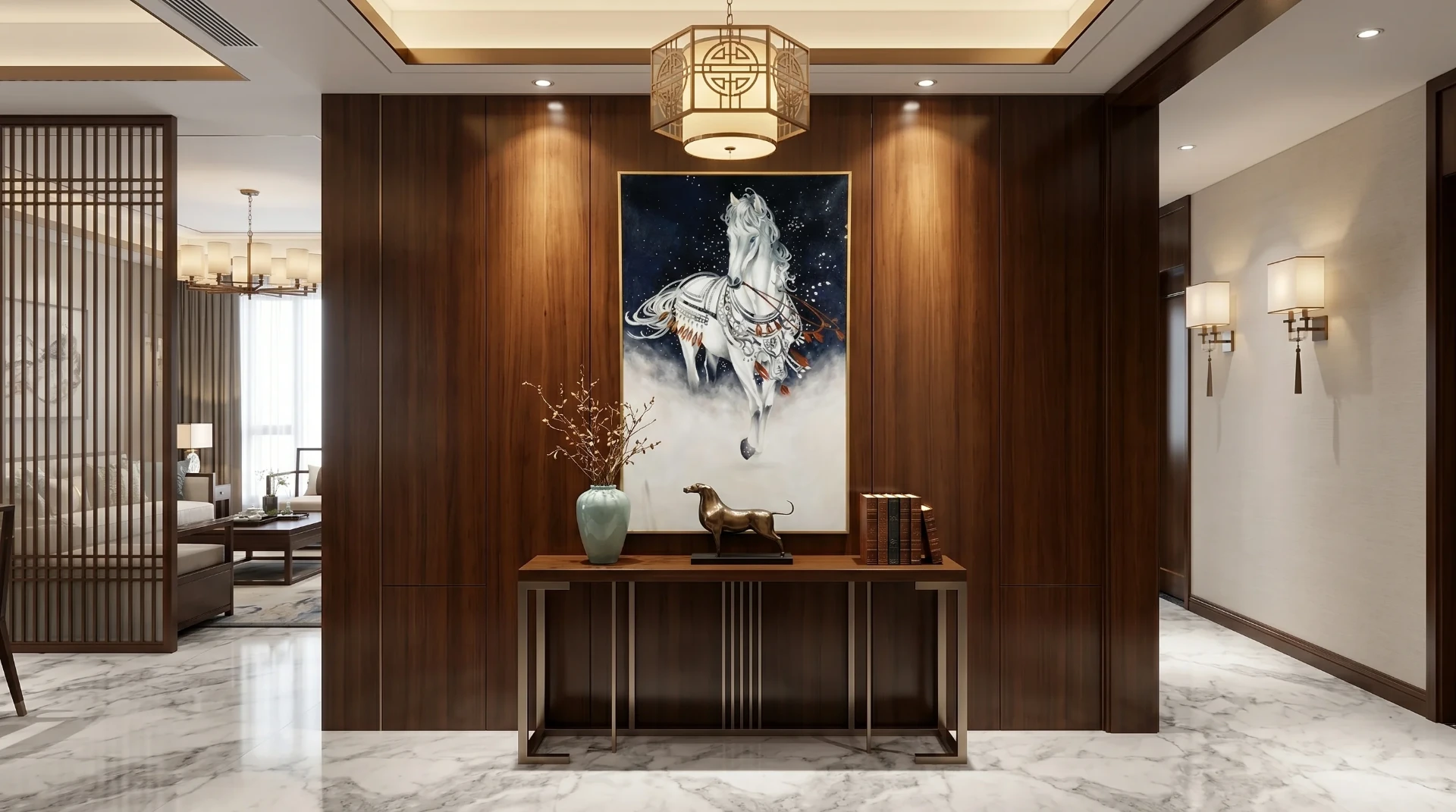
Wire structure plus mineral enamel rendered as picture — suited to collection, spatial display and shrine commissions.
Eastern enamel jewellery
The same craft, scaled down for the body — daily wear, cultural gifting and city-craft expressions of cloisonné.
Linghua’s contemporary eastern enamel.
Linghua Culture focuses on the contemporary expression of eastern enamel. The aim is not to replay tradition behind glass, but to bring this craft into collection, gifting, spatial display, intangible-heritage workshops and cultural collaboration.
- Cloisonné thangka
- Cloisonné painting
- Eastern enamel jewellery
- Cultural and corporate gifts
- Intangible-heritage workshops
- Bespoke gifting & channel partnership
The question we work from is not “how do we copy tradition?” but “how does this craft enter today’s life — as something that is actually worth displaying, wearing, gifting, collecting and passing on?”
What to look at when reading a piece.
- The line — is the wire steady; are the turns natural; is the spacing comfortable?
- The colour — is the enamel clean; is there layering; does the material itself give off light?
- The edge — where wire meets enamel is where craft shows itself.
- The subject — is it a recycled motif, or is composition, subject and craft truly working together?
- The scene — does the piece belong on a body, on a wall, on a shelf, in a collection, or inside a specific space?
A good cloisonné work should not only photograph well. It should read close up — and it should read across decades.
Cloisonné — the questions we are asked most.
Cloisonné is an enamelling technique in which thin metal wires form the outlines of a design and vitreous enamel is filled into the resulting cells. The line is not painted — it is a length of wire — and the colour is not pigment on a surface, it is mineral enamel settled inside a boundary.
Want to see cloisonné work up close?
If you are looking for a piece for collection, spatial display, cultural gifting, corporate commission, or an intangible-heritage workshop, you can continue with Linghua’s cloisonné painting, cloisonné thangka, eastern enamel jewellery and workshop programmes. We will match scene, budget, subject and delivery window with the right work.