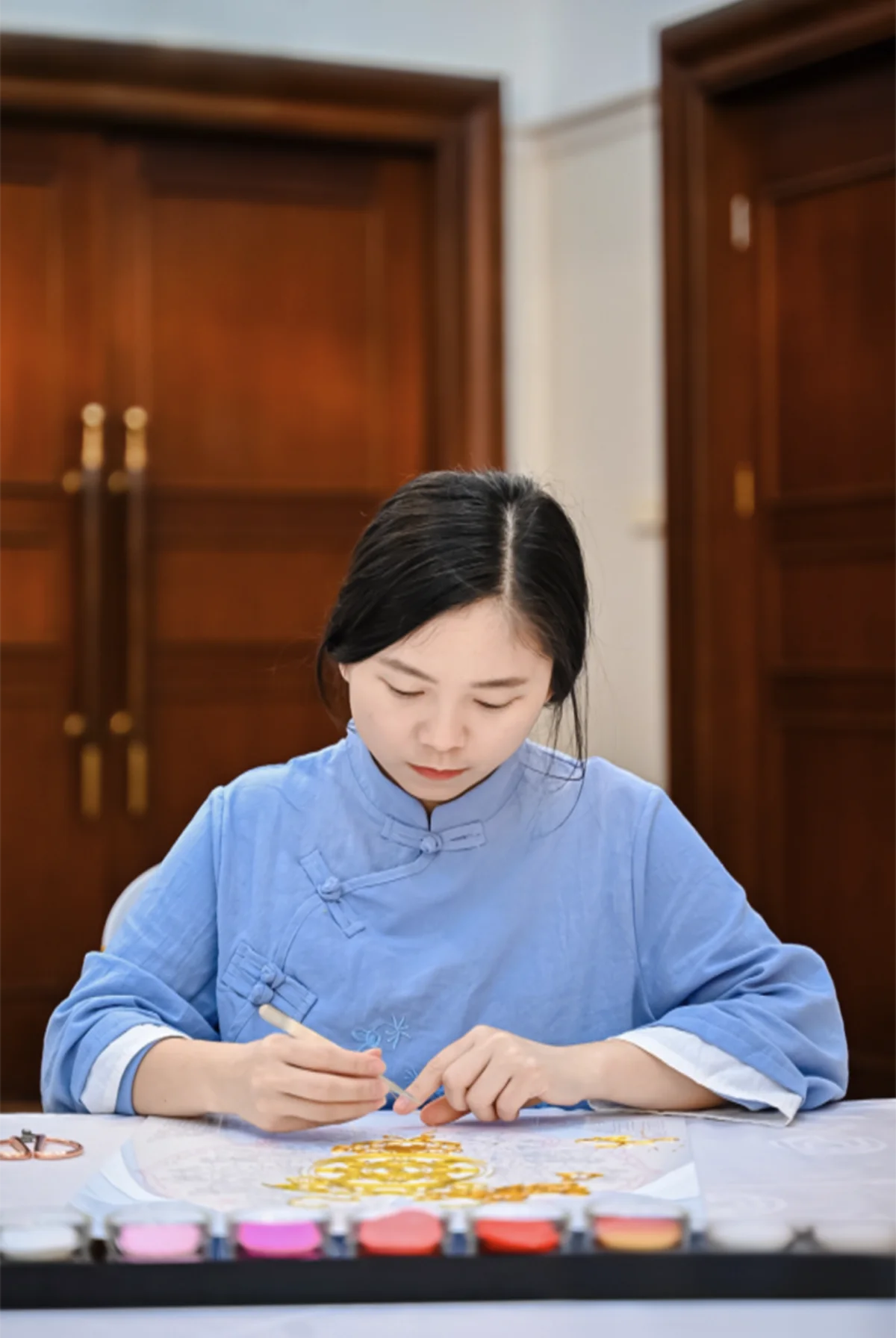
Design & Drafting
Each composition is drafted on copper sheet — iconography for thangka works follows Tibetan śāstra proportions; original works are sketched by the founder.
Cloisonné is one of China’s eight great imperial crafts and a national intangible cultural heritage. The Linghua atelier inherits both the northern jingtailan tradition of Beijing and the southern painted-enamel tradition of Canton.
Cloisonné enamel reaches its first imperial peak under the Jingtai emperor — the deep cobalt grounds give the craft its Chinese name, jingtailan (景泰蓝, "Jingtai blue").
The Qing Imperial Workshops codify the gilt-bronze body, fine copper wire and seven-firing technique that defines collectible cloisonné to this day.
In Guangzhou (Canton), painted enamel — guǎng falang — emerges as a parallel southern tradition, prized for its painterly colour and export to European courts.
Founder Linghua studies traditional Tibetan thangka iconography under master Sangpei at the Jokhang Temple, Lhasa.
Guangzhou Linghua Culture is established to fuse the northern cloisonné lineage with the southern painted-enamel tradition — collectible thangka, spatial enamel, gifts and wearable works.
Formally received into the lineage of Lingnan cloisonné painting under fourth-generation master Ren Jihong — recognised as a fifth-generation core inheritor.
A single collectible thangka measuring 60 × 80 cm requires four to six months of atelier work. Below is the canonical seven-stage process — every Linghua piece passes through each step, in this order, without shortcut.
Each composition is drafted on copper sheet — iconography for thangka works follows Tibetan śāstra proportions; original works are sketched by the founder.
Flattened copper wire — under 0.5 mm — is bent by hand into thousands of cloisons and set vertically to form every contour of the image.
Mineral enamel powders are wet-packed into each cloison with bamboo spatulas. A single thangka can require 60–120 distinct enamel colours.
The piece is fired up to seven times at 800 °C. After each firing the enamel sinks; the artisan refills, levels and fires again until the surface is flush with the wires.
Three successive abrasives — sandstone, charcoal and oilstone — bring the surface to a uniform satin finish without dulling the colour.
Exposed copper wires and rims are electroplated in 24 K gold, framing every cloison in luminous line.
The finished work is signed by the artist, numbered, sealed and issued with a certificate of origin recording materials, firing record and edition.
Fifth-generation core inheritor · Lingnan cloisonné painting · Master of Arts & Crafts
Linghua — born Deng Shan, 1987, Zhaoqing, Guangdong — is a contemporary Chinese cloisonné artist and the fifth-generation core inheritor of the Lingnan cloisonné painting tradition.
In 2008 she travelled to Lhasa to study traditional Tibetan thangka iconography under master Sangpei at the Jokhang Temple. From 2009 she trained across China under senior cloisonné masters in wire inlay, enamel packing and painted-enamel techniques. In 2010 she developed an original ambient-temperature enamel-setting process, extending cloisonné beyond the traditional copper body.
In 2017 she founded Guangzhou Linghua Culture to bring together the northern jingtailan lineage and the southern painted-enamel tradition of Canton. In 2025 she was formally received as a disciple of fourth-generation master Ren Jihong, securing her standing as a fifth-generation lineage holder.
Her collectible works have been awarded national gold medals at the 20th and 22nd Shenzhen ICIF, the Lingnan Craftsman Cup, the Lotus Award and the Chao-Gong Cup. In 2024 her work Phoenix Nirvana was permanently acquired by the Guangdong Museum of Arts & Crafts.
Guangdong Museum of Arts & Crafts permanently acquires the work "Phoenix Nirvana".
Guangdong Greater Bay Area Arts & Crafts Exhibition, gold medal.
National-level Cultural & Creative gold medal at China's flagship cultural industries fair.
First national gold medal for the atelier's collectible thangka work.
Recognised professional title; Board Director, Guangdong Arts & Crafts Association.
Every cloison is bent and set by the artisan's hand. No transfers, no decals — the line you see is the wire that holds the enamel.
We work with traditional silicate enamel powders, not acrylic paint. Colour does not fade, oxidise or yellow with time.
Collectible works are conceived and finished by the founder; studio assistants support only the most labour-intensive stages under direct supervision.
Each piece carries a certificate of origin, edition number and atelier seal — verifiable on request for insurance and resale.
Collectors, galleries and cultural institutions are welcome to schedule a studio visit. For partners outside China, we send a private digital catalogue with provenance, edition and shipping details.