BRAND STORY · LINGHUA CULTURE

Chinese cloisonné.
Jingtailan lineage.
The Linghua story.

Linghua is a contemporary Chinese cloisonné enamel atelier built around a single inherited technique — Lingnan cloisonné painting, a southern school of the 600-year-old Ming imperial craft jingtailan. Founded in Guangzhou in 2017 by fifth-generation lineage holder Linghua (Deng Shan), the studio makes collectible thangka, spatial paintings, ceremonial gifts and wearable enamel for collectors, museums and institutions across Asia, Europe and North America.

SEARCH INTENT · BRAND + HERITAGE + CRAFT

A brand story built to answer what collectors actually search for.

According to Semrush, the strongest English entry points around this topic are Chinese cloisonné, cloisonné enamel, jingtailan and Chinese cloisonné history. That means this page cannot be only a poetic brand statement — it must also clearly explain the craft, the lineage, the founder, and the present-day relevance of the studio.

The role of this page is therefore twofold: to establish Linghua as an author-led Chinese cloisonné atelier, and to give search engines enough semantic depth to understand why the studio is relevant for heritage craft, collecting, bespoke commissions and cultural collaborations.

600years

Of unbroken Ming-court technique behind every piece.

5thgeneration

Lingnan cloisonné painting lineage, held by the founder.

108operations

Hand-counted steps per mid-sized work — none mechanised.

1signature

Every work signed, numbered, and certified by Linghua personally.

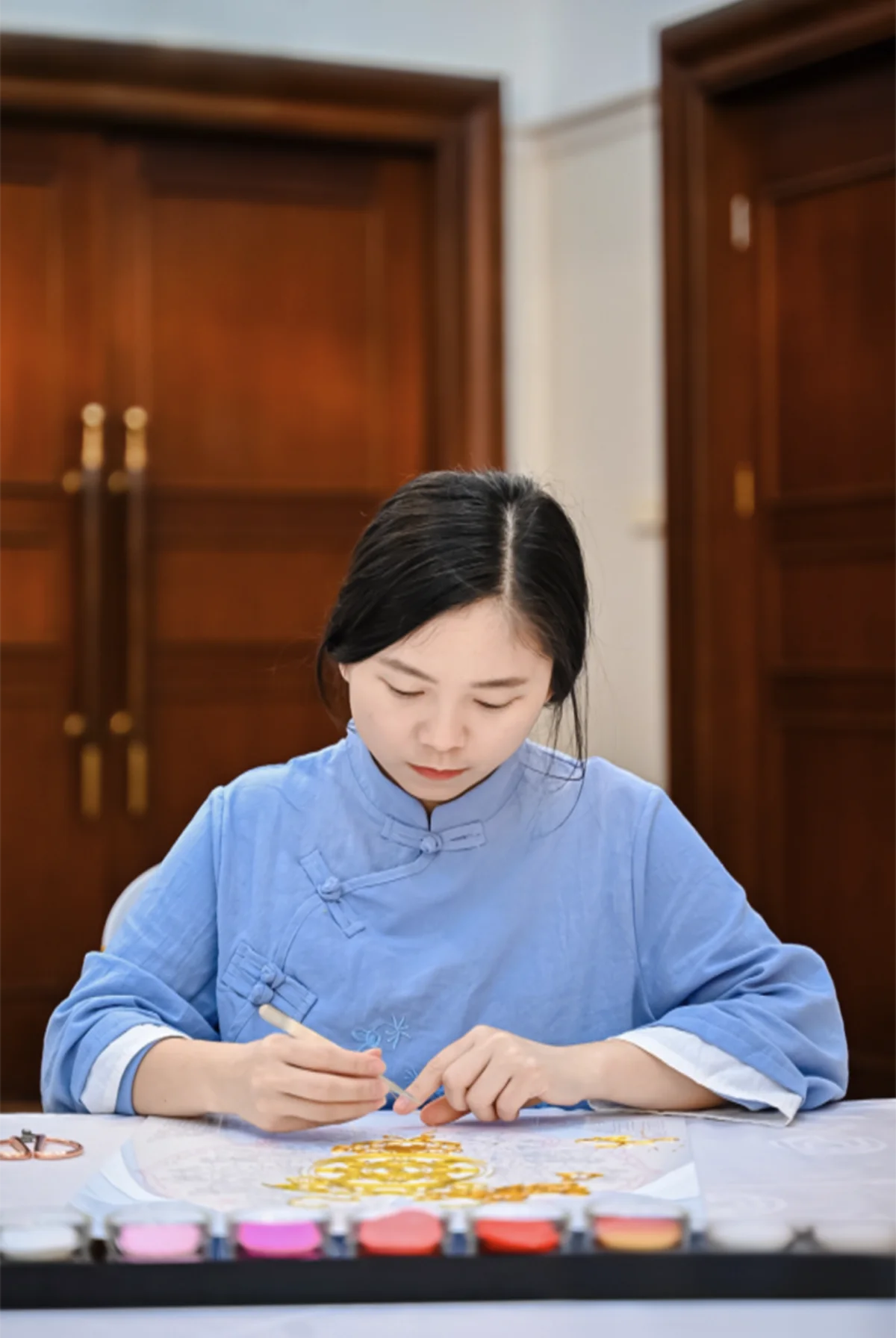
Linghua, fifth-generation Chinese cloisonné artist Deng Shan, holding a cloisonné enamel work in the Guangzhou atelier
Founder Linghua (Deng Shan), fifth-generation lineage holder of Lingnan cloisonné painting, pictured in the atelier in Guangzhou.
I
1450 · MING IMPERIAL COURT

A blue the court could not stop looking at.

Cloisonné enamel — what Chinese collectors call jingtailan (景泰蓝, "Jingtai blue") — entered the Ming imperial workshops in the mid-15th century and reached its first artistic apex under the Jingtai Emperor (r. 1450–1457). It was the only decorative medium the court treated as simultaneously painting, metalwork and chemistry.

For 600 years since, the technique has remained essentially unmechanised. There is no press for the wire, no transfer for the line, no shortcut for the kiln. A single mid-sized work still requires 108 distinct hand operations and four to eight firings at 800 °C — exactly the same count documented in the Jiajing-era imperial records.

II
1900s — 2000s · LINGNAN TURN

The southern school. A family lineage.

By the late Qing, cloisonné had migrated from Beijing’s imperial workshops into the literati ateliers of southern China — Guangzhou, Foshan, Zhaoqing. The Lingnan school favoured a softer line, a wider colour register, and pictorial subjects drawn from Tibetan Buddhist iconography rather than court symbolism.

It is in this lineage that the Linghua atelier sits. Four generations of women in the founder’s family — grandmother, great-aunt, mother — worked enamel before her, the craft passed by hand and not by school. The technique that arrived in her studio in 2017 had already been refined in private for a hundred years.

III
2017 · LINGHUA

A studio founded around a single conviction.

Linghua (Deng Shan, b. 1987, Zhaoqing) is the fifth-generation core inheritor of Lingnan cloisonné painting and a recognised Master of Arts & Crafts. She founded Guangzhou Linghua Culture in 2017 with a single conviction: that cloisonné would only survive as a living art if it stopped imitating the Ming and started answering the present.

Her work since has done exactly that — Tibetan thangka rendered in copper wire and mineral enamel; spatial paintings sized for contemporary architecture; cultural gifts commissioned by museums and embassies; wearable pieces in editions of 108 or 365. "Phoenix Nirvana" was acquired by the Guangdong Museum of Arts & Crafts as a permanent collection in 2024.

IV
TODAY · THE ATELIER

What we make, and what we refuse.

The atelier operates on the same scale as the Ming workshops did — small, named, signed. Every work is bench-built by Linghua and a hand-selected team of artisans; every piece is numbered, photographed at four angles, and issued with a bilingual certificate referencing materials, firing log and edition size.

We do not produce souvenir cloisonné. We do not licence the technique to factories. We do not accept commissions we cannot finish to lineage standard. The output is small by design: roughly thirty to sixty collectible works a year, across thangka, spatial painting, gifting and jewellery.

CHINESE CLOISONNÉ · SEARCH EXPLAINER

Chinese cloisonné, cloisonné enamel and jingtailan — how this page bridges the terms.

The English search landscape splits between broad art-historical vocabulary and Chinese cultural terminology. To rank and read well, the page has to connect those phrases naturally rather than stuffing them into metadata alone.

What is Chinese cloisonné?

Chinese cloisonné is an enamel art built from copper, hand-shaped wire and mineral glaze, then kiln-fired in repeated stages. In Chinese, the craft is widely known as jingtailan, named after the blue favoured during the Jingtai reign of the Ming dynasty.

Why does jingtailan matter now?

Collectors, designers and institutions increasingly search for living heritage rather than static replicas. Linghua positions jingtailan as a contemporary art language — keeping the historic process intact while shifting scale, iconography and use toward the present.

How is Linghua different?

Unlike mass-produced cloisonné souvenir workshops, Linghua works in a lineage-led atelier model: small editions, signed works, museum-grade documentation, and a practice that moves between collectible thangka, spatial painting, bespoke gifting and jewellery.

FAQ · SEARCH DEPTH

Questions collectors and researchers ask before they inquire.

What is the difference between cloisonné and jingtailan?

Cloisonné is the broader English term for enamel separated by metal wire cells. Jingtailan is the best-known Chinese name for that craft tradition, especially in relation to Ming court blue enamel. In practice, many international collectors use the terms together when searching for Chinese cloisonné.

Is Linghua a traditional workshop or a contemporary art atelier?

It is a contemporary atelier grounded in traditional technique. The studio preserves the hand-built cloisonné process, but the work itself is composed for present-day collectors, interiors, museums, ceremonial gifting and wearable art.

Does Linghua make original Chinese cloisonné works for international clients?

Yes. The atelier works with private collectors, cultural institutions, hospitality clients and brand partners in Asia, Europe and North America. Works can be acquired from existing collections or developed as bespoke commissions.

Why is a Linghua work produced in small numbers?

Because each piece is built by hand through a long enamel process that includes wire shaping, colour filling, repeated kiln firing, stone polishing, gilding and final documentation. Small output is essential to maintaining lineage standard and authorship.

MANIFESTO

We are not preserving a craft.
We are continuing it.

Cloisonné is alive when it makes work the present recognises as its own. The atelier exists to do that, slowly and signed — across thangka, spatial painting, gifting and jewellery.