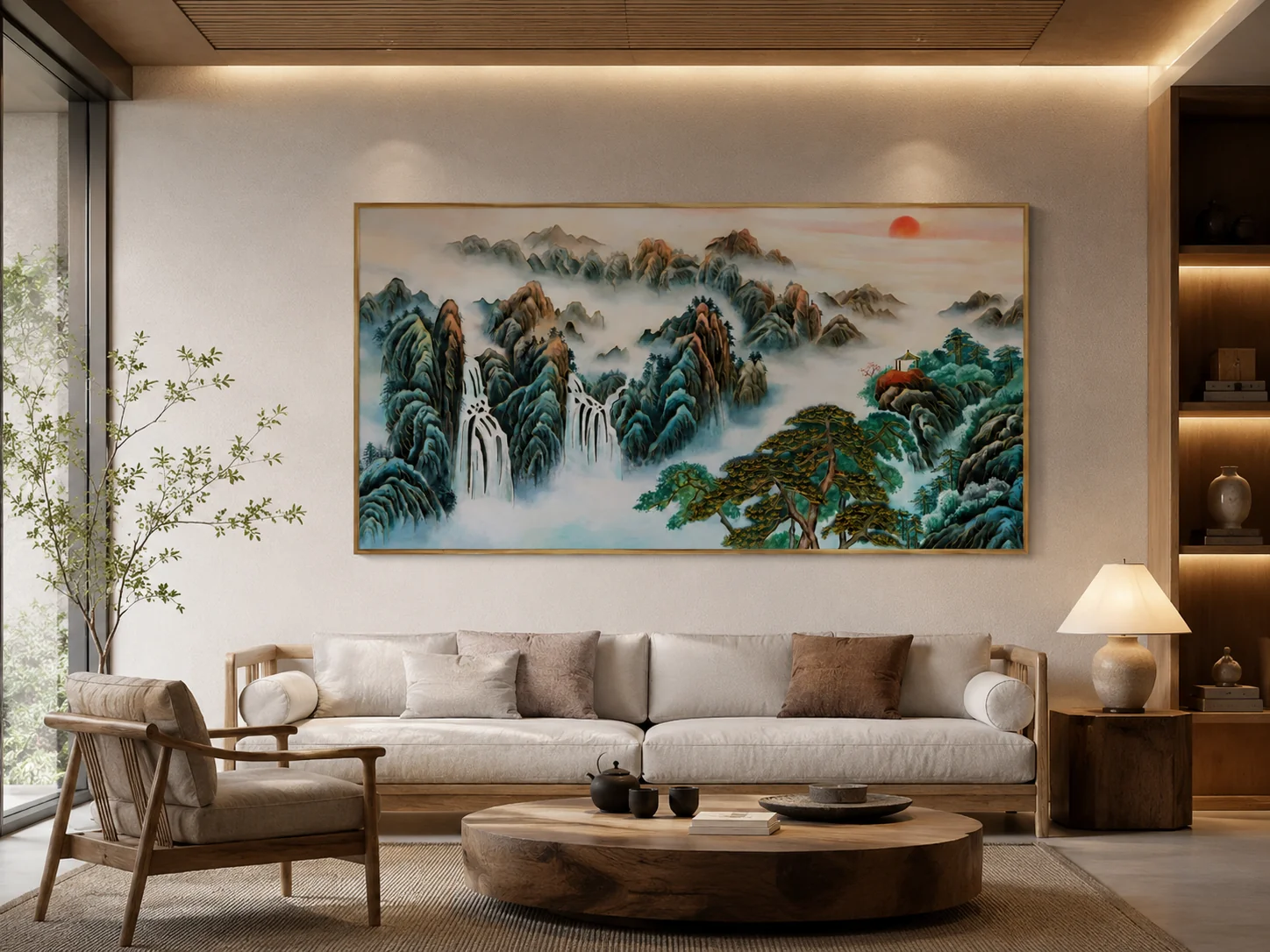
A process can be copied.
Judgement cannot.
The cloisonné process can be described and learned. The presence a finished piece carries cannot be reduced to a checklist.
When a wire must turn, where it must close, where it cannot stay straight;
when a colour must lift, where it must be pressed down, where the transition must breathe;
how a figure, a pattern or a Buddha image stops resembling and starts standing.
These judgements come from years of finished works, not from a manual.
For us, the question is never only whether the technique is complete — it is whether every detail serves the piece as a whole.
The four marks of a Linghua work
Line true. Colour held. Form standing. The whole, right.
The line must be true
A wire is never just an outline
In cloisonné enamel, the brass wire decides more than the contour of an image. It carries the structure, rhythm, posture and breath of the finished work.
- — Too rigid, and a figure freezes.
- — Too soft, and the composition loosens.
- — A wire closed without care will drag the whole passage down.
Our wire-inlay standard asks every line to serve the piece, not simply to sit on it.
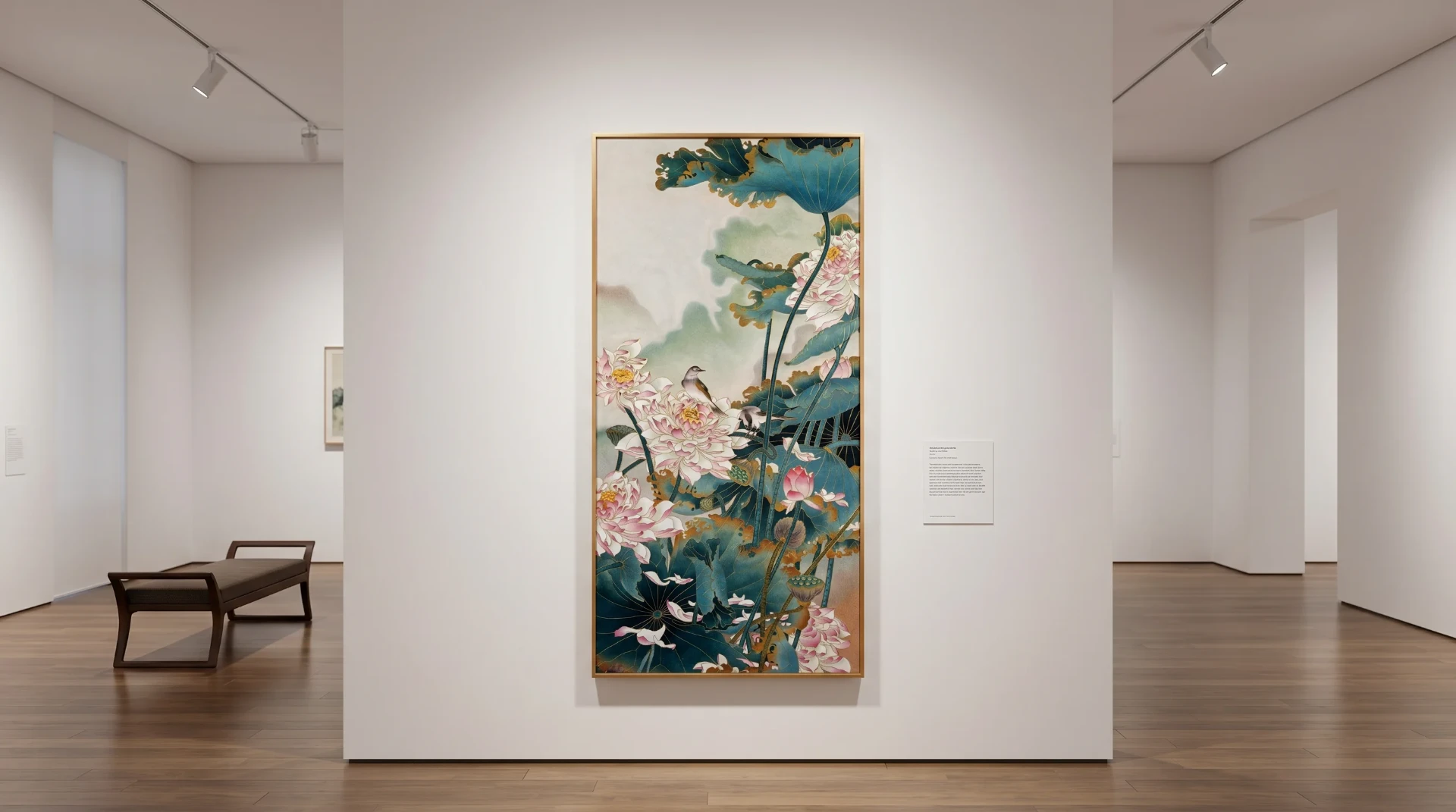
The colour must hold
Enamel is never just filled in
Depth, temperature, grain and transition decide whether a cloisonné surface has layers, weight and breath — or stays flat.
- — Too even, and the work feels thin.
- — Too sharp, and the surface fragments.
- — A transition pushed too fast breaks the rhythm of the piece.
We let colour grow into the work, rather than land on it.
The form must stand
An image cannot merely resemble
Thangka, deities, figures, ornament, vessels — none of them are finished by copying a drawing. A serious cloisonné work asks the image to stand on its own: with posture, with force, with spirit.
- — A warrior cannot go soft.
- — A Buddha cannot float on the surface.
- — Ornament cannot scatter; vessels cannot turn ordinary.
We use wire and enamel to rebuild the presence of an image — not to trace it.

The whole must be right
However good a detail is, it returns to the whole
A work is not the sum of its best fragments. Line, colour, image, negative space, rhythm, edge and reflection must all answer back to the single breath of the piece.
- — Too full, and the work feels closed.
- — Too tidy, and the surface dies.
- — Too scattered, and the piece loses its centre.
We do not judge a work by what is sharpest in it, but by whether the whole has truly arrived.
How a cloisonné work is made — from drawing to finished piece
Every step is a procedure. Every step also asks for a judgement.
Drafting
Define the subject, structure, image relationships and overall direction.
Base preparation
Prepare board, body or carrier appropriate to the format of the work.
Wire inlay
Bend and set brass wires to draw structure, ornament and local contour.
Enamel mixing
Tune colour, grain and tonal layers to match the spirit of the piece.
Filling enamel
Lay enamel paste into the cells formed by the wires, resolving local colour relationships.
Local adjustment
After the first pass, refine line closures, tonal depth, edges and rhythm.
Enamel firing
Set the enamel grain and tonal layers, preserving the hand-built texture of the surface.
Finishing
Edge work, full review, mounting and delivery.
The process gets the piece made. Judgement is what lets it arrive. After each step we look again — is the line true, the colour holding, the form standing, the whole, right?
Why we keep adjusting
a single small detail
Most adjustments are not made because something is wrong. They are made because the work has not yet arrived.
From the outside, you see details. We see the work.
One bright note
A touch of light, placed so the surface can breathe.
One short wire
A shortened line, set so the breath of the piece can hold.
One sharp tip
A sharpened point, used so the image truly stands.
One staggered beat
A slight offset, kept so the composition has rhythm.
The more complex the work,
the more judgement it asks for
Cloisonné thangka, Buddhist iconography, mandalas and other complex Eastern subjects are never finished simply by following a drawing.
A complex work carries structure, proportion, hierarchy, colour order and a particular spiritual register. To rebuild all of that with wire and enamel, the maker has to understand the image, the material, the technique and the breath of the whole at once.
A single judgement that worked in a small piece is amplified, again and again, inside a complex one. That is why our craft standard is not a slogan — it is the only way the larger works arrive.
From cloisonné thangka to spatial enamel paintings, cultural gifts and cloisonné jewellery, the formats change. The standard we hold to does not: line true, colour held, form standing, the whole, right.
Keeping the grain
and the light of the enamel
We work to preserve the grain, the tonal layering and the trace of the hand inside each enamel surface. Those small textures are what turn a cloisonné panel from a flat image into something that lives between light, colour and material.
A serious cloisonné enamel work should not only carry vivid colour. It should also carry settled depth, fine transition, and details that hold up under close inspection.
Brand Overview
Mission, voice and the world we work in.
The Founder
Linghua — fifth-generation Lingnan cloisonné inheritor.
Brand Story
How a centuries-old craft re-entered contemporary life.
Brand History
Six centuries of cloisonné, four stages of the atelier.
Studio & Team
Design, atelier, operations — how Linghua delivers.